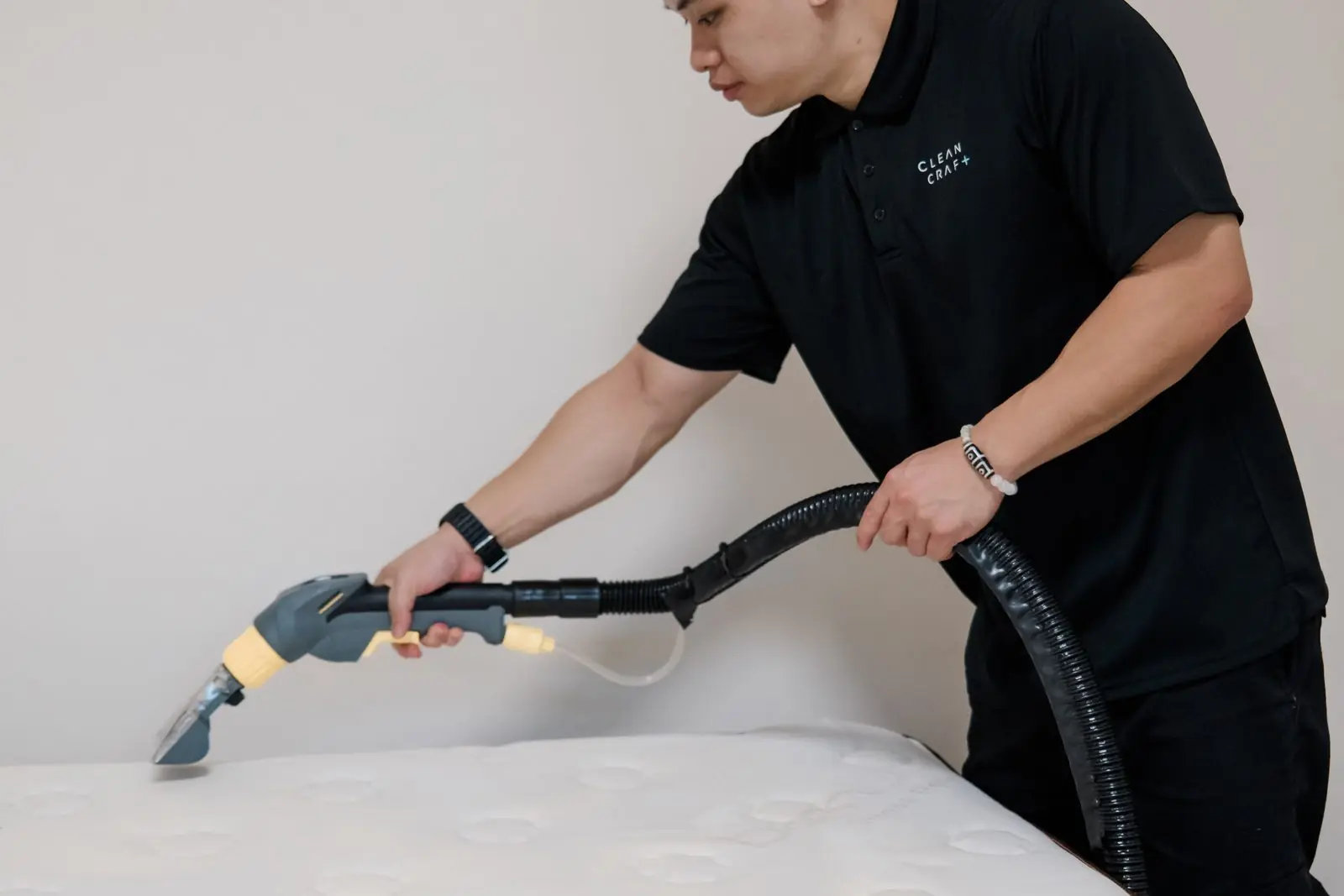
Dust mites live in the layers of a mattress and feed on the skin you shed. Washing bedding at 60°C kills the mites in the bedding, and nothing you do to the bedding reaches the mattress underneath. Getting what is inside the mattress out of it takes extraction rather than treatment.
- Washing bedding at 60°C kills the mites in it. A 30 or 40 degree wash does not.
- A household vacuum lifts the top layer and does not reach what has settled below the ticking.
- Mites take moisture from the air and struggle below roughly 50 per cent relative humidity. Singapore sits near 80.
- Dry extraction is the step that physically pulls the mites, skin and dust out of the mattress layers.
- Cleancraft's dry vacuum extraction with UV-C sterilisation targets dust mites without chemicals.
What are dust mites, exactly?
Dust mites are microscopic relatives of spiders, far too small to see. They do not feed on you. They feed on the flakes of dead skin that people and pets shed constantly, and a mattress is where the largest amount of that skin collects. Warm, humid, and full of food — a mattress is, from a dust mite's point of view, prime real estate.
A single mattress can host hundreds of thousands of them. Dust mite allergen is a recognised trigger for some people, and whether it affects anyone in your home is a question for a doctor rather than for a cleaning company. This guide stays on what collects in a mattress and what gets it out.
It helps to picture the cycle. You shed skin flakes as you sleep; the mites eat them and multiply; they produce waste; that waste dries, breaks into fine particles, and mixes into the mattress. Every night you top up their food supply, and the colony maintains itself. So a mattress that is never deep cleaned does not hold steady. The material in it accumulates.
Why Singapore homes are especially prone
Dust mites do not drink. They take moisture from the air around them, which is why the humidity of a room decides whether they can live in it. Below roughly 50 per cent relative humidity they struggle, and above it they do not. Singapore sits around 80 per cent for most of the year, with no cold, dry season to slow a colony down the way a temperate winter does.
Air-conditioning helps a little by lowering humidity in the room, but the inside of a mattress stays warm and holds moisture from body heat and sweat. So even in an air-conditioned bedroom, the mattress itself remains a friendly environment. This is why local homes often need more deliberate management than advice written for cooler climates suggests.
How to get rid of dust mites in your mattress
| Method | What it physically does | What it leaves behind |
|---|---|---|
| Washing bedding at 60°C | Kills the mites in sheets, covers and pillowcases, and washes the debris out | Everything inside the mattress itself |
| Washing at 30 or 40°C | Cleans the fabric | The mites, which survive a wash at these temperatures |
| Household vacuuming | Lifts loose material from the top layer of the ticking | Most of what has settled below the surface |
| Airing in the sun | Dries the mattress and lowers the moisture mites depend on, for as long as it stays dry | The mites and the debris, both still in place |
| Freezing | Kills mites in small items that fit in a freezer, such as a soft toy | Not a method for a mattress |
| A mattress protector | Puts a washable barrier between you and the mattress interior | Whatever is already inside |
| UV-C light | Treats micro-organisms on the surfaces the light directly reaches | The mites, shed skin and dust, none of which light removes |
| Dry extraction | Draws loose and embedded debris out of the mattress layers | Set-in stains and odours |
| Wet extraction | Lifts what has soaked in, using a pre-treatment | Needs drying time afterwards |
Control the humidity
Keeping the bedroom cooler and drier, with air-conditioning or a dehumidifier, makes the whole room less hospitable. The number to aim below is roughly 50 per cent relative humidity. Worth knowing before you buy a dehumidifier: getting a Singapore bedroom that low and holding it there is difficult, so treat this as a help rather than a fix.
Wash bedding in hot water
Wash sheets, pillowcases and the mattress protector weekly at 60°C. The temperature is the part that matters: a 30 or 40 degree wash cleans the fabric but the mites survive it. Heat is one of the few things that reliably kills mites in fabric, and the wash carries away the allergens they have already deposited.
Use a mattress protector
A tightly woven, washable protector puts a barrier between you and the mattress interior. It will not remove an existing colony, but it slows new build-up and is easy to launder.
Vacuum regularly
Vacuuming the mattress surface with an upholstery attachment lifts loose allergen debris, and it is worth doing whenever you change the sheets. Its limit is depth. A mattress is a stack of layers, and the skin cells mites feed on are heavier than dust, so they work down through the weave of the ticking and settle in the layer below. A household vacuum pulls air across a surface without the airflow or the agitation to draw material back out of a layered structure.
Sanitise the mattress professionally
To actually reduce an established colony rather than just tidy the surface, you need extraction force and a way to sanitise what gets disturbed. That is the gap a professional service fills, and it is the step home methods cannot replace.
Where else dust mites hide in the bedroom
One method works on the small items and nowhere else: freezing. A soft toy that fits in a freezer can be treated that way, which is useful in a child's bedroom. It is not a method for anything mattress-sized.
The mattress holds the most, but it is not the only reservoir. Dealing with the mattress alone and ignoring the rest lets the colony refill. Worth attention:
- Pillows. Like the mattress, they collect skin flakes and moisture. Wash washable pillows hot, and have non-washable ones sanitised.
- Duvets and blankets. Launder them hot on a regular cycle, not just when they look dirty.
- The headboard and bed frame. Fabric headboards gather dust and allergens the same way a mattress does.
- Soft furnishings nearby. Curtains, rugs, and an upholstered chair in the bedroom all hold allergens and feed the cycle.
Thinking of the bedroom as one system, rather than the mattress in isolation, is what keeps the allergen load down between deep cleans.
How professional sanitisation targets dust mites
Our mattress sanitisation is built for this exact problem. We use dry vacuum extraction with integrated UV-C germicidal light. The extraction pulls dust mites, their droppings, and the dead skin they feed on out of the mattress layers, while the UV-C treats bacteria, mould, and viruses. It is a dry method, with no chemicals and no drying time, so the bed can be made the same day and it suits cot and children's mattresses.
Where a mattress also has staining or odour, we add wet extraction: a pre-treatment spray and high-pressure extraction to lift what is set into the fabric. Every solution we use is non-toxic and safe around children and pets.
Mattress sanitisation runs from $30 for a baby cot to $150 for a king, depending on the size and on whether the mattress needs the dry service alone or steam or wet extraction as well. Pillows are $5 each, usually the smallest line on a quote. Full rates are on the mattress sanitisation page.
Fabric sofas and headboards hold dust mites too, so if the mattress is a problem the surrounding furniture often is as well, and our upholstery cleaning uses the same approach.
Frequently asked questions
Do dust mites bite?
No. Dust mites do not bite or burrow into skin. If you have bite marks, the cause is something else, such as bed bugs or mosquitoes.
Can I get rid of dust mites completely?
Realistically you manage them rather than eliminate them forever, because they exist wherever there is warmth, humidity, and skin flakes. But you can cut their numbers and the allergen load dramatically with humidity control, hot washing, and periodic professional sanitisation.
How often should I sanitise my mattress for dust mites?
For most homes, every six to twelve months is a sensible rhythm. Closer to every six months suits a bed shared by two people, a child's mattress, or a bed a pet sleeps on. Three other moments are worth catching: a new mattress before first use, because it has been stored and transported; a second-hand or inherited mattress before anyone sleeps on it; and any mattress coming out of storage.
Does UV-C light kill dust mites?
UV-C is a germicidal light that treats bacteria, mould, and viruses on the surface it reaches. In our service it works alongside dry vacuum extraction, which is what physically removes the dust mites and their debris from inside the mattress. The two steps do different jobs.
Book a mattress sanitisation
Tell us the mattress size and whether there are any stains, and we will quote on WhatsApp. If there are no stains we will quote the dry service rather than the more expensive one.